

Comrades from the Communist Party and Red Youth were joined by representatives from the embassies of Venezuela, Cuba and DPR Korea to celebrate the anniversary of the Great October Socialist Revolution. Our close friends from the Chinese state news agency Xinhua were also present to celebrate this joyous occasion.

In a packed Saklatvala Hall a spirited meeting heard speakers from the central committee of the CPGB-ML, the embassies of Cuba, Venezuela and Korea, Harsev Bains from the I.W.A (G.B) and two leading members of Red Youth.
Our international guests recalled the heroic struggles for national liberation, independence and socialism which were and continue to be waged as a result of the glorious October Revolution. In the speeches of comrade Dan and Angela, Red Youth speakers declared:
“We still talk about the October Revolution today because all the lessons it teaches us are still relevant, perhaps moreso now than ever before both in our country and internationally.
In the UK over a fifth of young people are unemployed, with a similar rate across Europe. In countries such as Spain and Greece the rates today reach 56% and 61% respectively. Everyone knows why we’re facing this current capitalist crisis – the irresponsibility of bankers, the greed of the corporate elite, and the complicity of these governments in the destructive imperial capitalist machine. And yet every measure directed to stave off complete financial collapse has been directed at the working classes; cuts to health, cuts to transport, taxes on spare bedrooms, measures that will only affect the very poorest. Many families are now relying on food banks, or having to make the choice whether to go to bed hungry or cold as fuel prices relentlessly increase.
This is not to mention the already existing disparity between the working classes and the elite. Whereas the 7% of pupils that can afford to attend independent schools make up 39% of the students at top universities the poorest 33% of students only make up 6%, no wonder when parliament is filled with millionaires….
The revolution and the changes that followed inspired similar events in China, Cuba, Vietnam, Korea, and many other countries. No longer in the Soviet Union and these other socialist countries was a full education the preserve of the wealthy, health care wasn’t just for those that could afford it, access to employment, housing, and food wasn’t based on whether or not you had the connections or luck to secure a job in tough economic times. And these revolutions were necessarily not just economic – they were social too, doing away with any notion of privilege related to gender or race. Every single metric relating to quality of life improved.
So we will celebrate the October Revolution every year, and we will share the lessons it has taught us and the rest of the working class, that we have a duty to form a vanguard party and to educate the working classes, to teach people that there is an alternative to slaving away for the bourgeoisie in return for cuts to public services, mass unemployment, homelessness, and starvation. Hence the motto of Red Youth: Each One, Teach One!“
More photo’s of the event will appear here shortly.
Come and celebrate the Great October Socialist Revolution!
09 November 2013 (6.00pm)
Saklatvala Hall, Dominion Road, Southall, UB2 5AA
This annual event should be a fixture in everyone’s diary. An inspiring meeting and social celebrating the historic achievements made possible by the Great October Socialist Revolution. This year, we will be marking the 96th anniversary of the October revolution with a full programme of speeches and cultural performances, followed by good food and socialising with comrades.
VIDEOS OF PREVIOUS CELEBRATIONS
Red Youth recommends watching this documentary!
Obama’s formation of an Africa Corps, and the renewed determination of the Nato imperialist powers to dominate the continent of Africa, remind us how important it is to mark this occasion, and to renew our struggle to rid the world of the scourge of imperialism – the enemy of all working and oppressed people.
At this moment, millions of African workers, like all the oppressed masses of humanity, are struggling against aggressive imperialist plunder – whether it takes the form of economic domination, IMF ‘restructuring’ and slow starvation, or of political destabilisation and direct military intervention in those countries where the path of independence has been boldly taken.
Nato’s genocidal campaign against Libya, and recent imperialist interventions in Cote D’Ivoire, Mali, and Sierra Leone, as well as the ongoing imperialist intrigue and manipulation in other states – Uganda, Rwanda, Egypt, Tunisia, etc – remind us of this harsh reality.
As imperialism’s economic, diplomatic and military might falls on the brave and independent people of Syria, where in the media do we read of the USA’s ongoing genocidal proxy war for the plunder of coltan (without which Silicon Valley, and the entire computer and mobile phone industries, would grind to a halt) from the long-suffering Congolese people?
The 5 million Congolese victims of this war apparently warrant no moral outrage; they are the everyday sacrifice made on the high altar of capitalist profit, and highlighting their plight does not serve the imperial strategic agenda.
Imperialism seeks domination, not democracy! Let us never forget it.
Lenin said that the struggle against imperialism would be a sham and a fraud unless it was inseparably bound up with the struggles for national liberation of the toiling millions of ‘colonial slaves’.
In our allegedly ‘post-colonial’ era, following the fall of the Soviet Union and the renewed aggression and arrogance of Anglo-American imperialism in particular, the pressure of imperialism on its former colonies is greater than ever.
Let us then remember the words of Amilcar Cabral, founder of the PAIGC (African Party for the Independence of Guinea and Cape Verde):
“I should just like to make one last point about solidarity between the international working class movement and our national-liberation struggle. There are two alternatives: either we admit that there really is a struggle against imperialism which interests everybody, or we deny it.
“If, as would seem from all the evidence, imperialism exists and is trying simultaneously to dominate the working class in all the advanced countries and smother the national-liberation movements in all the underdeveloped countries, then there is only one enemy against whom we are fighting. If we are fighting together, then I think the main aspect of our solidarity is extremely simple: it is to fight.” (‘Brief analysis of the social structure in Guinea’, Seminar given in Milan, 1-3 May 1964)
Let us resolve to build unity in our struggle against capitalist imperialism, against neo-colonialism, and admit that if a better world is possible, it is our duty to forge the means for bringing it into being.
Workers of all countries, unite! We have nothing to lose but our chains! We have a world to win!
Video report available from rt.com

“Grandson of Josef Stalin filed a suit against the Russian parliament, demanding to admit that his grandfather was not guilty of the Katyn Massacre of 1936-1938.
75-year-old Evgeny Gzhugashvili demands a review of the acknowledgement stating that the “Katyn crime was committed at the direct order of Stalin and other Soviet leaders.”
This is not the first suit filed by Gzhugashvili Jr. Over the years, he has been actively suing newspapers and journals that call Stalin an executioner.
In April 2011, he called on the State Duma to consider its Katyn resolution, paying him 100 million rubles ($3 million) in compensation. The Supreme Court dismissed his claim, explaining that the Katyn events have no effect on Stalin’s reputation.
The Katyn case has long complicated the Russia–Poland relationship, in 2010 Russia began to release documents related to the Katyn mass execution to the Polish authorities.
Over 14,000 Polish officers were imprisoned and brought to the territory of the USSR in 1939. In 1943 reports emerged that the Soviet side executed the officers in the Katyn forest, located 14 kilometers west of the city of Smolensk.
For decades, the Soviet regime denied responsibility for killing the officers and Polish officials in Katyn and other areas of Russia, blaming it on “Nazi criminals”. However, in 1990, the Itar-Tass news agency published a release announcing the Katyn case as one of the worst crimes of the Stalin era. Declassified documents showed that 22,000 Polish prisoners were killed in a special operation by NKVD police on March 5, 1940.
In November 2010, the State Duma adopted the statement acknowledging that it was Stalin who ordered the Katyn shooting.
In April 2011, all the declassified Katyn case documents were handed over to Poland.”
To learn about Katyn read this: The Katyn Massacre
And to learn the truth about the rest of the propaganda, read this: Lies concerning the history of the Soviet Union

The correspondence below was written by a CPGB-ML member in response to an article that appeared on MediaLens.org titled ‘Structural inclinations – the leaning tower of propaganda: chemical weapons attacks in Ghouta, Syria’ on 9 October.
We publish this not as an attack on Media Lens, whose work we value and respect, but as an exposure of the debilitating ideological castration that separates peace-loving people in the imperialist countries from adopting a class position on questions of war and peace; from turning imperialist war into a war on imperialism, from taking a resolute stand with the oppressed against the oppressors and unifying the workers in the imperialist countries with their brothers and sisters who resist in the oppressed countries.
1) Dear Media Lens
I was horrified to see the extent to which the imperialist bias that you make it your business to expose in corporate journalism has infected your own view of events in Syria.
In your recent article on the chemical weapons propaganda, you felt constrained to emphasise twice — at the beginning and at the end of your article — that President Assad of Syria is a ‘war criminal’. And, just like the journalists you excoriate, you offered not a shred of evidence for this assertion.
Near the beginning of your article you wrote, by way of an apology for criticising the corporate media’s ‘house lefties’:
The point is not that Aaronovitch, Hasan and Monbiot are wrong – the Assad dictatorship has committed many horrific war crimes, and may have again in Ghouta.
And at the end, having yourself referred to just some of the evidence that, when put together, makes it quite clear that the Syrian government did NOT carry out the recent chemical weapons attack in Ghouta, you undermined your whole article with the following statement:
Again, none of this means that the Syrian government, and indeed Assad himself, was not to blame for the August 21 attacks.
For any right-thinking person not infected with colonial prejudice, it is perfectly clear to see that President Assad is a popular, unifying leader in a country that has faced escalating hostility from imperialism for decades.
He heads a government that has been freely elected and which comprises members of many parties — a national-unity coalition, in fact. Syria’s government is far more democratic and representative than our own. Did you know that 50 percent of the seats in the Syrian parliament are reserved for workers? Since you so casually refer to it as a ‘dictatorship’ — as if that was established fact — I can only assume that you did not.
President Assad’s only ‘crime’ is to be the leader of a nation that has refused to ‘know its place’. He unites people from all backgrounds and presides over a much-valued secular state in a region where sectarian hatred has been deliberately fostered (and armed) by outsiders for generations.
Anti-imperialist, independent Syria has stood up to US and British corporate and military interests and to zionism. It has given real, physical support to Palestinian and Iraqi resistance and refugees — at great cost to itself. It has spent its resources on providing free education and health care, on keeping food prices low, and on limiting the activities of the very bloodsucking international corporations you also claim to oppose. It has refused to allow its people to become yet more disposable sweatshop-fodder for the world’s financial elite.
For decades, Syria has stood side by side with Iran and the Lebanese resistance to form a counterweight against Israeli (and therefore imperialist) dominance of the Middle East. It has supported countries all over the world — through both trade and diplomacy — that are trying to carve an independent furrow and lift their people out of the superexploited poverty that western imperialists have consigned them to.
So why should it be that you, who claim to want peace and harmony in the world, and an end to the domination of the imperialist corporations, have such a knee-jerk, hostile reaction to a leader and a government who are actually putting your supposed programme into action by standing up to the forces of imperialism? Why are you so quick to come down against David and agree with Goliath?
The only answers I can come up with are laziness and prejudice. You must have relied on vested interests for information in order to so casually refer to ‘dictator Assad’. And you would seem also to have accepted the right of the free-market fundamentalists who control our media to judge and label their opponents.
But any schoolboy critic of the system can tell you that words like ‘dictator’ and ‘undemocratic’ when used by our corporate media are simply code for ‘uppity native getting in the way of our profit-taking’. Can it be that, despite all your years of opposing the propaganda machine, this simple truth has so far eluded you?
Be that as it may, since you have set yourselves up as an independent voice that purports to expose the bias of the corporate media, it behoves you to find out the truth about the people that the West is demonising. And even if you can’t be bothered to to that, it ought to be a very minimum requirement that you not make categoric statements like ‘the Assad dictatorship has committed many horrific war crimes’ without backing them up.
I can assure you, if you think you have evidence, there are plenty of people out there who can help you see through it. Like so much of today’s propaganda, it will turn out to be paper thin.
Over the years, I have subsidised your work (when able), read your books and bought them for friends, followed your alerts and forwarded/shared them around. I have considered the work you do to be extremely useful to progressive humanity. You have written many things I disagreed with, but I considered you to be thoroughly critical in your thinking and aware that the narrative passed down to us by officially-sanctioned history books and the corporate media is written by vested interests and aimed at keeping us quiescent in the face of Britain’s hideous imperial crimes.
Which only makes your refusal to recognise the lies being told about President Assad and the Syrian government more baffling and disappointing.
I very much hope you will publish a full retraction of statements that — whether you mean them to or not — are reinforcing the lies of the corporate war propaganda machine, and therefore supporting what you yourselves have identified as a criminal war effort.
Sincerely yours
JB
2) Hi
Thanks for your email and support in the past.
Assad is certainly not head of the kind of system we would consider democratic. We’re not alone in that view. Noam Chomsky has commented:
‘First of all, Israel was not opposed to Assad. He has been more or less the kind of dictator they wanted.’
In 2011, Amnesty reported:
‘The authorities remained intolerant of dissent. Those who criticized the government, including human rights defenders, faced arrest and imprisonment after unfair trials, and bans from travelling abroad. Some were prisoners of conscience. Human rights NGOs and opposition political parties were denied legal authorization. State forces and the police continued to commit torture and other ill-treatment with impunity, and there were at least eight suspicious deaths in custody.’
You write:
“But any schoolboy critic of the system can tell you that words like ‘dictator’ and ‘undemocratic’ when used by our corporate media are simply code for ‘uppity native getting in the way of our profit-taking’.”
That’s often true but the corporate media doesn’t have a monopoly on the use, or intended meaning behind the use, of particular words. We can use the same words without intending anything of the sort. We have often quoted Ralph Nader on the US political system:
‘We have a two-party dictatorship in this country. Let’s face it. And it is a dictatorship in thraldom to these giant corporations who control every department agency in the federal government.’
In quoting Nader, we didn’t intend to suggest that the US was an uppity native getting in the way of profit-taking.
You write:
“For any right-thinking person not infected with colonial prejudice, it is perfectly clear to see that President Assad is a popular, unifying leader in a country that has faced escalating hostility from imperialism for decades.”
We didn’t say Assad wasn’t popular or unifying. We’ve often pointed out that Syria has faced escalating attacks from external forces of the kind you’re describing. We wrote that the Assad dictatorship ‘has committed many horrific war crimes’. That’s really undeniable. For example, Robert Fisk has cited Syrian army officers who made it very clear that they had not been taking prisoners. The Syrian air force has clearly been bombing civilian areas, also a war crime, and so on. As in any war, the government and head of government are responsible for all crimes of this kind.
Best wishes
DE Media Lens
3) Dear Media Lens
From your reply it’s clear that you are relying on supporters of the system for your information.
‘Human rights NGOs’ are usually backed by the same corporations who control the rest of our media. They are the missionaries of our time, clearing the way for imperial crimes by preaching to the oppressed and spreading slanders about them while pretending to be ‘independent’ of the imperial machine.
They present themselves as ‘neutral arbiters’, but a hefty proportion of what they put out is outright lies, while the rest is distorted through the mirror of western corporate interests.
And who appointed these western ‘NGOs’ as arbiters of rights anyway? Isn’t the first right of people everywhere to be allowed to live in peace? To just live??? Amnesty International led the war propaganda effort for the destruction of Libya with total lies. Its leaders loudly and shamelessly laid the groundwork for a genocide against black Libyans and the almost total destruction of 40 years of civilisational advance — then quietly retracted their lies when the war was over. MSF have been doing the same in Syria by spreading unfounded lies about the use of chemical weapons based on nothing but the say-so of Nato’s death squads.
Robert Fisk and Noam Chomsky are similar ‘left-wing’ imperialists of the type that you are usually quite good at spotting. They are ‘safe’ critics because they never question the really big lies on which the whole ideological edifice of this rotten system rests. If they weren’t such tame critics, you probably would never have have heard of them! I know you have a thing for Chomsky, but I would not rely on him for information for a second. In the case of Syria, he reinforces the western narrative by describing the terror gangs there as a legitimate liberation struggle that has been forced to arm itself. So yes actually, it is perfectly deniable that President Assad is the author of ‘horrific war crimes’ — not only Assad and Syria deny it, but so do most of progressive and oppressed humanity.
There is no civil war in Syria. The US, British and French imperialists are fighting a PROXY WAR. Civilians caught up in terrorist campaigns universally report on how many foreign accents and even languages there are amongst the fighters — who have mostly been drafted in from abroad. These mercenaries are not patriots. They have been trained by their masters to be utterly brutal (ie, killing and kicking out huge numbers of civilians from their homes, kidnapping young children and using chemical weapons on them in order to take photos and blame the deaths on the Syrian government). They recognise no rules of engagement. No crime is too barbaric for them. They are true servants of the Nato nazis.
Syria is fighting for its life as an independent and proud nation against the most powerful forces this planet has ever seen. Are you really saying that you (or Robert Fisk, come to that) are in a position to judge their tactics? One brutal battle where some bloody nasty terrorists got killed does not make the leader of a government into a war criminal. Especially when that government is trying to defend its people’s fundamental right to life by standing up against a criminal onslaught. They are trying not to become the next Afghanistan, the next Palestine, the next Congo, the next Iraq or the next Libya. They are trying to prevent the next middle-eastern genocide.
Do you think the Syrian government would remain popular if it was seen to be bombing its own civilians? Does that actually make sense if you stop to think about it? Why are the Syrian army greeted everywhere as liberators if that’s how they conduct warfare?
There has been a difficulty with ‘democratic freedoms’ in Syria. Where is there not? In Syria’s case, these limitations were a direct result of imperialist and zionist warfare, not the random whim of some mythical ‘evil tyrant’. Countries that stand up to imperialism are forced to take defensive measures. They are under constant attack on all fronts all the time – economically, militarily, via the media and through sabotage and infiltration. In order to allow people to keep going to school, to keep living in their subsidised housing, eating their subsidised food and using their free hospitals, the government had to protect the system that provided those from collapse at the hands of outside agents.
Think Britain during WW2. The country was in a state of emergency. People were asked to be vigilant against alien activity. Democracy was curtailed. Were there good reasons for it? Did the people understand it? Would you therefore characterise Churchill’s government as a brutally oppressive regime of war criminals? [In fact, it’s a bad comparison, as Churchill really was a war criminal and a nasty racist piece of work, but you take my point, I hope.]
Syria has been in a state of emergency, a state of war, since Israel occupied the Golan Heights. It has been constantly infiltrated by spies and saboteurs and, of course, some Syrians are in the pay of these forces. Do you honestly believe that a country under such attack should not take any steps to defend itself? Would you like to see imperialism being given free reign to control every corner of the planet? How do you expect countries to defend themselves if not by ‘oppressing’ those who want to hand the country over to the forces of free-market fundamentalism?
But it is not the job of peace-lovers and anti-imperialists to condemn the victim for trying to stop a crime. We should be pointing our fingers at the criminals and exposing their dastardly activities, not helping them to justify their vicious attacks.
The imperialists are angry only because the measures such states take to protect themselves are to a certain extent effective against their attempts to effect regime change from within, by subversion and manipulation. ‘We should be able to control your political and economic life’ is what calls by the imperialists for ‘open government and democracy’ really amount to. They are total doublespeak. Is it really so hard to see that?
Are you aware that the genuine ‘popular protests’ that the West homed in on and infiltrated as an excuse to trigger its proxy war were against market reforms that had been forced through by the IMF? Did you know that a structural adjustment programme had opened up parts of the economy to corporate investors and led to higher prices and unemployment? That the demonstrations were essentially a result of Syria having made concessions to the great economic pressure that has been brought to bear for decades by the imperialists?
Did you know that the real protestors considered President Assad to be on their side in their call for greater democracy (a lightening of the state of emergency) and for a return to a more nationalised economy and better opportunities for young people? Did you know that the mass of people backed a new constitution two years ago and back the government today? If you knew these facts you would not be so quick to believe the stupid lies about Assad ‘clamping down’ on protestors, ‘firing on his own people’, etc etc.
It is documented that terrorist snipers and armed men attacked police at faked ‘protests’ in order to portray the government as ‘brutal’ and justify their impending war — a war that has been in the planning for at least a decade.
Governments get demonised by the West precisely when they do manage to stand up for themselves and protect their people. While imperialism exists in the world, people will have to find ways to deal with that reality. They didn’t create the situation. They didn’t ask to be in the firing line. I’m sure they would like nothing better than to be left the hell alone to develop their economy and their culture in peace.
But that’s not what happens is it?
Why are we in the imperialist countries allowed to identify with the nobly vanquished victim and loudly wish that the world was not so unjust, but not to give any real support to those who are trying not to be the next victims of this barbaric system? Should we not be pulling out all the stops to help those on the front line who are actually doing something to change the balance of forces in favour of the oppressed?
And if Assad is popular, unifying and freely elected, where the hell do you get off calling him a ‘dictator’?
It’s time to dig a little deeper and decide which side you are really on. There are no neutral arbiters in this world.
Sincerely yours
JB
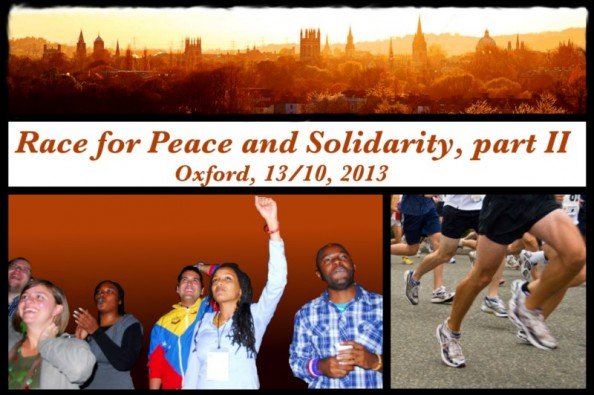
Oxfordshire comrades are raising money to support the Red Youth delegation to the World Festival of Youth and Students in Ecuador this December. Over £900 has already been raised from previous efforts and there is more planned this month. Please consider making a donation: http://www.gofundme.com/4o87rw

The latest attempt to divert workers’ burning desire for change down pointless avenues of non-activity takes support for imperialism to a new level by including a class A war criminal amongst its leading lights.
On 30 November, London’s Royal National Hotel is set to be the venue for the founding conference of yet another self-proclaimed party, purporting to represent the interests of working people in Britain.
Since making an initial appeal in March, Left Unity claims, in a letter published in the Guardian on 12 August, that “more than 9,000 people have signed up and more than 100 local groups have been established across the country”. (‘Left Unity ready to offer an alternative’)
Sounds impressive – and at least in part this apparent surge in support does reflect the mass and growing sentiment for what Left Unity’s self-appointed leaders describe as “a genuine alternative to the austerity policies which the three main parties support”.
However, this apparent support is as genuinely shallow as it is apparently wide. First, it is based on the most flimsy of bases – namely, an appeal to “all those who are sick of austerity and war, who want to defend the NHS and our public services, and want to see a fairer Britain, to join us”.
Secondly, much of the claimed support is of the Facebook type – but clicking ‘Like’ is a long way away from building a viable party.
As a result, much of this claimed support will not survive the first puff of a gentle late autumn breeze, let alone the harsh gales of the class struggle.
Similar vacuity is to be found in the prescription offered by the authors of the above-quoted Guardian letter, with their call: “We urgently need a new party of the left. Labour will not provide the opposition to coalition policies that the situation demands. We need to provide a genuine alternative to the austerity policies which the three main parties support. A party that is socialist, environmentalist, feminist and opposed to all forms of discrimination.”
Their letter begins: “This summer will be remembered for Labour’s final betrayal of the working-class people it was founded to represent. Not content with signing up to Conservative austerity measures that are dragging Britain’s most vulnerable people deeper into poverty, Ed Miliband has turned his back on the union members who supported his leadership bid.”
In other words, a petty spat between Ed Miliband and his chief bankroller, Unite’s Len McCluskey, takes precedence over a century of Labour’s betrayal of the working class and oppressed people at home and abroad and over the blood of millions of people slaughtered in Labour’s imperialist wars, from Malaya to Korea, from Aden to Ireland, and from Yugoslavia to Afghanistan to Iraq.
In analysing Left Unity therefore, it is necessary to focus less on its claimed 9,000 ‘Facebook friends’ and more on the small group of people driving this initiative.
Who is behind Left Unity?
The original impetus came from new husband and wife team Kate Hudson and Andrew Burgin. Both are prominent members of the Stop the War Coalition (and its semi-secretive ‘officers group’), while Kate is best known for being the current (paid) general secretary of the Campaign for Nuclear Disarmament (CND) and previously its (unpaid) chair.
Like her predecessors in CND, Kate used this position to propagate bourgeois pacifism to the working class (‘disarm yourselves while the ruling class gets tooled up’) and to denounce progressive countries like the DPRK for pursuing modern technology (satellites) and choosing to arm themselves in the face of the ever-present threat of imperialist attack.
A former London District Secretary of the Communist Party of Great Britain (CPBG), in its final dying days, she has since served stints in the Communist Party of Britain (CPB), Socialist Action and Respect.
Her stint in George Galloway’s Respect was something of a whirlwind romance. Joining together with Andrew just after their marriage, she was almost immediately installed as the party’s parliamentary candidate in a Manchester by-election, only to withdraw her candidature, whilst insisting she would stay a party member, following the furore caused by some unfortunate remarks made by George on the subject of rape in the context of his commenting on the politically-inspired charges being levelled at WikiLeaks founder Julian Assange.
But the pledge to stay and fight in Respect did not last long once she and Andrew discovered that they had been removed from the National Committee. Kate has long been known to be fascinated by the idea of regrouping diverse sections of the left in Europe into broad-front parties, following the collapse of the European socialist countries, and has published two books on this subject. She and Andrew are apparently particularly impressed by the recent strong electoral showing of Greece’s Syriza – and the belief that this can somehow be replicated here has impelled the launch of Left Unity.
Whilst our party is crystal clear on the fact that it is only a vanguard party firmly schooled in and equipped with the science of revolution, Marxism Leninism, that can lead the proletariat and its allies to victory in its struggle against exploitation and oppression, we are by no means opposed to united fronts on particular questions or to unity in struggle in pursuit of agreed objectives and against common enemies.
But, as indeed flows inexorably from this, there has to be at least some minimum benchmark against which such matters can be evaluated. In the case of the first initiators of Left Unity, the hopelessness, and indeed often the venality, of Stop the War and CND notwithstanding, a clear rejection of all imperialist wars would not seem to be too much to ask for.
Alas, right from the start, Left Unity has failed that most basic test. Surrounding themselves with a familiar cast of ‘luvvies’, Kate and Andrew promptly secured the support of veteran film director Ken Loach (notorious for his Land and Freedom, a disgraceful anti-communist film, maligning the Spanish Republic and the heroic International Brigades), and, a little later, China Miéville, a popular science-fiction writer and one of a considerable number of people to have recently decamped from the Socialist Workers’ Party (SWP) following the rape allegations directed at one of its leading members. (Ironically, the SWP had used Galloway’s remarks on the same subject in an attempt to excoriate him. Its own actions in dealing with the allegations were clearly much worse.)
However, this is by no means the worst. Also climbing on the bandwagon has been the Trotskyite sectlet Socialist Resistance, whose own passion for ‘left regroupment’ is driven by the classic Trot modus operandi of a parasite needing a host – or ‘entryism’, as it is often grandly called.
Thanks to the disastrous tie-up with Socialist Resistance, the third signatory, along with Kate Hudson and Ken Loach, to Left Unity’s initial appeal (as well as subsequently, for example, in the above-quoted Guardian letter) was one Gilbert Achcar, a professor of middle-eastern studies at London’s School of Oriental and African Studies (SOAS), and, more importantly, a rabid proponent of imperialist war against Libya and Syria, and a man who bears and shares political responsibility for the deaths of hundreds of thousands of people in those dirty wars of aggression.
War criminal Achcar
These are, of course, strong charges – so, distasteful as it will undoubtedly be for our readers, we intend to fully condemn Achcar in his own words.
Faced with some limited exposure of his political crimes by others on the left, Achcar has resorted to obfuscation, denial and lies, pompously declaring: “I will not waste my time and that of the readers in reminding them here of what I really stood for.”
But the pompous professor cannot dismiss the working-class movement as airily as an undergraduate attempting to submit a late essay. It is a matter of fact that Achcar has not only supported (or as he has sometimes disingenuously put it “refused to oppose”) wars of aggression; he has also provided advice and huddled together in conclave with the intelligence assets of US and French imperialism to discuss the prosecution of those wars.
In March 2011, two days after the passage of UN Resolution 1973, which led to the unleashing of a war of massive proportions against Libya, Achcar published an interview praising that war as a humanitarian operation, aimed at preventing a massacre of civilians in Benghazi.
While noting that “there are not enough safeguards in the wording of the resolution to bar its use for imperialist purposes”, Achcar said: “But given the urgency of preventing the massacre that would inevitably have resulted from an assault on Benghazi by Gaddafi’s forces, and the absence of any alternative means of achieving the protection goal, no one can reasonably oppose it … You can’t in the name of anti-imperialist principles oppose an action that will prevent the massacre of civilians.”
In another article, he wrote: “If Gaddafi were permitted to continue his military offensive and take Benghazi, there would be a major massacre”; and “from an anti-imperialist perspective one cannot and should not oppose the no-fly zone, given that there is no plausible alternative for protecting the endangered population”.
Of course, the only massacre that did occur was the one unleashed by imperialism, cheered on and encouraged by Achcar, who, as we shall see below, essentially confined his criticism of the imperialists to their apparently not being bestial enough.
He went on to describe the rats, who very shortly became notorious for their racist massacres of black Libyans, and who, directed and abetted by imperialism, destroyed all the civilisational achievements of the Libyan people, built up over more than four decades, as “a mixture of human-rights activists, democracy advocates, intellectuals, tribal elements, and islamist forces – a very broad coalition … The bottom line is that there is no reason for any different attitude toward them than to any other of the mass uprisings in the region.”
Achcar repeatedly demanded that Nato funnel even more weapons to Libyan terrorist militias. Thus, in a largely sympathetic comment on Obama’s April 2011 speech on the war, he said the best way to “enable the uprising to win, in conformity with the Libyan people’s right to self-determination, is for the hypocritical western governments – who have sold a lot of weapons to Gaddafi since the arms embargo was lifted in October 2004, and Gaddafi turned into a model – to deliver arms to the insurgency”.
Finally, as Libyan government forces began to collapse under relentless Nato air strikes in August 2011, Achcar actually criticised Nato for not striking Libya harder!
He issued a statement citing right-wing Wall Street Journal columnist Max Boot’s observation that Nato warplanes had flown 11,107 sorties against Libya, but 38,004 sorties in the 1999 war against Yugoslavia.
He wrote: “The crucial question then is: why is Nato conducting an aerial campaign in Libya that is low-key not only in comparison with the air component of the war to grab similarly oil-rich Iraq, but even compared to the air war for economically unimportant Kosovo? And why is the alliance at the same time refraining from providing the insurgents with the weaponry they have consistently and insistently requested?”
In a more recent piece, Achcar sought to distort the facts surrounding his October 2011 meeting in Sweden with Burhan Ghalioun, the first chairman of the opposition Syrian Transitional National Council (SNC). During this meeting, he advised Ghalioun not to call for a Nato invasion of Syria – which would risk provoking mass popular opposition – but rather for “indirect” intervention to arm opposition forces.
In the event, this is exactly the policy that Nato and its regional stooges ultimately pursued, arming the SNC and other islamist opposition forces, including some tied to al-Qaeda, leading to a terrible war in which the Syrian people have suffered bitterly.
Subsequently, Achcar has denounced as a “canard” claims that “I took part in a meeting of the Syrian National Council (whereas it was actually a meeting of the left-wing National Coordination Council) in order to urge them to call for an imperialist intervention in Syria (whereas my contribution to the meeting was dedicated to exactly the opposite)”.
His denial is simply rubbish and lies. He himself publicly announced that he had met with Ghalioun and described his advice to the SNC in an article published in November 2011 in the Lebanese daily Al Akhbar. The French Trotskyite New Anti-Capitalist Party (NPA) reposted the article, as did the English-language website International Viewpoint, the journal of the wing of the Trotskyite Fourth International which Achcar, the NPA and Socialist Resistance all adhere to.
In this article, he wrote: “I was able to attend the meeting of the Syrian opposition that was held on 8-9 October in Sweden, near the capital, Stockholm. A number of male and female activists operating in Syria and abroad joined with prominent figures from the Syrian Coordination Committee (SNC – who had come from Syria for the event) in the presence of the most prominent member of the Syrian National Council – its president, Burhan Ghalioun.”
Achcar can lie all he wants, but the evidence of his crimes is splattered all over the internet, in his own words.
In April this year, he gave an interview to Amandla (a leftist South African publication opposed to the ANC and the South African Communist Party) calling for the arming of the Syrian terrorists:
“As in Libya, it [Washington] refuses to deliver weapons to the insurgency despite insistent requests … The truth is that the war has dragged on much longer than it might have, had the insurgency received weapons.”
He continued: “Every general rule admits of exceptions. This includes the general rule that UN-authorised military interventions by imperialist powers are purely reactionary ones, and can never achieve a humanitarian or positive purpose.”
Writing in the Lebanese Al Akhbar, he advised the Syrian counter-revolutionaries as to how they might best secure foreign intervention:
“The Syrian opposition must define a clear stance on the issue of foreign military intervention, since it is clear that its position has a major influence on whether or not intervention might take place. The reluctance regarding direct intervention that we see today on the part of western and regional states might change tomorrow if intervention requests made on behalf of the Syrian opposition were to increase.
“It was the Libyan National Council’s request for international military intervention at the beginning of March that paved the way for the similar request issued by the Arab League, and the subsequent resolution of the UN Security Council. Had the Libyan opposition opposed direct military intervention in all its forms (instead of just opposing intervention on the ground and requesting air support, as it did), the Arab League would not have sought intervention nor would such action have been sanctioned by the UN.”
By 1 September, following the vote in the British parliament against taking overt military action in Syria (see separate article in this issue), Achcar was at it again. Writing on the Open Democracy website, he was at pains to appear to welcome the vote – but only because the type of military action he believed was being contemplated did not go far enough for his liking.
Writing as a “staunch opponent of the Syrian Baathist regime”, he stressed that he welcomed the vote “even though, on the face of it, the decision in this instance spared one of the most ruthless and murderous dictatorships”, but continued, referring to those parliamentarians who had voted against war:
“They did so not out of ‘pacifism’ for sure, let alone ‘anti-imperialism’, but for the same reason that made western opinion makers in their vast majority display a patent lack of sympathy for the cause of the Syrian popular uprising. This reason is above all the lack of confidence in the Syrian uprising, as US Joint Chiefs Chairman General Martin Dempsey openly confessed most recently.”
Let Professor Achcar continue:
“The third reason to welcome the parliamentary vote is the one most directly predicated on my resolute support to the Syrian popular uprising. The military action that is being contemplated by Washington is about dealing the murderous Syrian regime a few military blows in order to ‘punish’ it for the use of chemical weapons against civilians.
“I have hardly any doubt that the Syrian regime did resort to such weapons in its barbaric onslaught on the Syrian people … But this begs the question: is killing up to fifteen hundred people with chemical weapons more serious a crime than killing over a hundred thousand with ‘conventional’ weapons? Why then does Washington want to strike now suddenly after placidly watching the Syrian people being slaughtered, its country devastated, and survivors in the millions turned into refugees and displaced persons?
“The truth is that the forthcoming strikes are only intended as a means to restore the ‘credibility’ of the US and its allies in the face of an alliance of the Syrian, Iranian, and Russian governments that has taken full liberty in escalating the war on the Syrian people despite all US calls for compromise …
“These strikes will not help the Syrian people: they will increase the destruction and death toll without enabling the Syrians to get rid of their tyrant. They are not intended for this latter goal. In fact, Washington does not want the Syrian people to topple the dictatorship: it wants to force on the Syrian opposition a deal with the bulk of the regime, minus Assad …
“However, by denying the mainstream of the Syrian opposition the defensive anti-aircraft and anti-tank weapons that they have been requesting for almost two years, while Russia and Iran were abundantly purveying the Syrian regime with weapons (and recently with combatants from Iran and its regional allies), the US administration only managed to achieve two results: on the one hand, it has allowed the Syrian regime to keep the upper hand militarily and thus to believe that it can win; hence, the regime has had no incentive whatsoever to make any concessions …
“Had western powers really cared for the Syrian people – or even had Washington been more clever in creating the conditions for the compromise it has been seeking – it would have been easy for them to equip the Syrian opposition with defensive weapons, thus enabling the uprising to turn the tide of the war in such a way as to precipitate a break-up of the regime … It is this reality that refutes the argument of many well-meaning people that arms should be denied to the Syrian opposition because the death toll will be increased.”
He concluded his article with these words: “In the face of the horrible crimes being perpetrated by the Assad regime with the support of Russia, Iran and Iran’s allies, it is the duty of all those who claim to support the right of peoples to self-determination to help the Syrian people get the means of defending themselves.”
He further provided his own brief summary by means of a letter carried in the Evening Standard of 2 September, where he wrote:
“All Washington is contemplating, however, is dealing the Syrian regime a few hits to punish it for having used chemical weapons repeatedly. The message is thus: ‘You can carry on slaughtering your people but we forbid you to use weapons whose impact could cross your borders, harming our allies in Israel, Turkey, Jordan and Lebanon.’ Such strikes will merely increase the death toll without speeding up resolution of the conflict.
“The only way to achieve this latter goal is to equip the [mythical] mainstream secular opposition with the defensive anti-aircraft and anti-tank weapons it has been requesting for almost two years.”
After this, doubtless tiresome and tortuous, digression through the depraved mind of Professor Achcar, one is surely entitled to ask: Of what possible benefit can a political outfit with such a criminal in one of its driving seats be to the working class?
In fact, Achcar’s ravings remind us of nothing so much as these never-to-be-forgotten words of JV Stalin:
“But it follows from this that present-day Trotskyism can no longer be called a political trend in the working class. Present-day Trotskyism is not a political trend in the working class but a gang without principle, without ideas, of wreckers, diversionists, intelligence service agents, spies, murderers, a gang of sworn enemies of the working class, working in the pay of the intelligence services of foreign states.” (‘Mastering Bolshevism’, report to the CC of the CPSU(B), 3 March 1937)

This excellent article is reproduced from Invent The Future
On 10 April 1993, one of the greatest heroes of the anti-apartheid struggle, Chris Hani, was gunned down by a neo-fascist in an attempt to disrupt the seemingly inexorable process of bringing majority rule to South Africa. Although direct legal culpability for this tragic assassination belonged to only two men – a Polish immigrant by the name of Janusz Waluś and a senior Conservative Party MP named Clive Derby-Lewis – the crime formed part of a much wider onslaught against the ANC and its allies. This onslaught – paramilitary, political, legal, psychological, journalistic – was not primarily conducted by fringe lunatics such as Waluś and Derby-Lewis, but by the mainstream white political forces and their puppets within the black community (such as the Inkatha Freedom Party). The leaders of the ANC, and particularly the MK (Umkhonto we Sizwe, the armed liberation movement with which Chris Hani’s name will forever be associated) were subjected to a wide-ranging campaign of demonisation. This campaign created conditions such that political assassinations of anti-apartheid leaders became expected, almost inevitable. Of course, the more ‘dovish’ leaders of the main white party, the National Party, were quick to denounce Hani’s assassination; but the truth is that they were at least partly responsible for it.
Speaking at Hani’s funeral, Nelson Mandela spoke of this phenomenon: “To criminalise is to outlaw, and the hunting down of an outlaw is regarded as legitimate. That is why, although millions of people have been outraged at the murder of Chris Hani, few were really surprised. Those who have deliberately created this climate that legitimates political assassinations are as much responsible for the death of Chris Hani as the man who pulled the trigger.”
Turning to the current situation in Syria, we see a parallel between the “climate that legitimates political assassinations” in early-90s South Africa and a media climate that legitimates the “limited military strikes” being planned in Washington.
The Syrian state has been under direct attack by western imperialism for the last two and a half years (although the US and others have been “accelerating the work of reformers” for much longer than that). The forms of this attack are many: providing weapons and money to opposition groups trying to topple the government; implementing wide-ranging trade sanctions; providing practically unlimited space in the media for the opposition whilst effecting a near-total media blackout on pro-government sources; and relentlessly slandering the Syrian president and government. In short, the western media and governments have – consciously and deliberately – “created this climate that legitimates” a military regime change operation against Syria.
An anti-war movement that takes part in war propaganda
Building a phoney case for imperialist regime change is, of course, not unusual. What is really curious is that the leadership of the anti-war movement in the west – the people whose clear responsibility is to build the widest possible opposition to war on Syria – has been actively participating in the propaganda and demonisation campaign. Whilst opposing direct military strikes, they have nonetheless given consistent support to the regime change operation that such strikes are meant to consummate.
Wilfully ignoring the indications that the Syrian government is very popular, Tariq Ali – perhaps the most recognisable figure in the British anti-war movement – feels able to claim that “the overwhelming majority of the Syrian people want the Assad family out”. Indeed, he explicitly calls for foreign-assisted regime change, saying “non-violent pressure has to be kept up externally to tell Bashar he has to go.”
Rising star of the British left Owen Jones used his high-profile Independent column of 25 August this year (just as the war rhetoric from Cameron, Hollande and Kerry was reaching fever pitch) to voice his hatred of the “gang of thugs” and “glorified gangsters” that run Syria, before worrying that “an attack could invite retaliation from Iran and an escalation of Russian’s support for Assad’s thugs, helping to drag the region even further into disaster.” Jones evidently doesn’t know very much about Syria, but that doesn’t stop him from participating in the Ba’ath-bashing: last year, his response to a bomb attack in Damascus which killed several Syrian ministers was the gleeful “Adios, Assad (I hope)”.
According to Stop the War Coalition national officer John Rees, “no-one can minimise the barbarity of the Assad regime, nor want to defend it from the justified rage of its own people.” Any objectively progressive actions ever taken by the Syrian government (such as its support for Palestine and Hezbollah) are nothing more than “self-interested and calculated acts of state policy” – which claim is rather reminiscent of the Financial Times accusing Hugo Chávez of “demagogy” in pushing for land reform in Venezuela!
Rees is only too clear that the number one enemy for Syrians is the government, and that pro-west sectarian Saudi-funded rebels are a secondary enemy – a position virtually indistinguishable from the Israelis, who state: “We always wanted Bashar Assad to go, we always preferred the bad guys who weren’t backed by Iran to the bad guys who were backed by Iran.” Further, Rees believes that what is really needed is to “give the revolutionaries the chance to shake off their pro-western leaders and defeat Assad.” That’s presumably if they’re not too busy eating human hearts or murdering people on the basis of their religious beliefs.
These are not isolated examples. It is decidedly rare to find a British anti-war leader mentioning Bashar al-Assad and his government in anything but an intensely negative light. Bashar is “brutal”; he is a “dictator”; he should be indicted at the International Criminal Court. Frankly, this leader of independent, anti-imperialist Syria is subjected to far more severe abuse from the mainstream left than are the leaders of Britain, France and the US. In the imperialist heartlands of North America and Western Europe, the defence of Syria has been left to a small minority, although thankfully the (far more important) left movements in Venezuela, Cuba, Nicaragua and elsewhere have a much richer understanding of anti-imperialist solidarity.
At the risk of stating the bleedin’ obvious: if you’re trying to spread anti-war sentiment and build the most effective possible movement against military action, then taking part in the demonisation of the country under threat is probably not a very smart strategy.
This campaign of propaganda, lies and slander has been very effective in creating a public opinion that is ambivalent at best in relation to the attack that is under preparation. Whilst most people may be “against” bombing Syria in principle, to what extent are they passionate enough to actually do anything to prevent this criminal, murderous act from taking place? Two million people marched against war in Iraq (and given the right leadership, they would have been willing to do considerably more than just march); yet no demonstration against war on Syria has attracted more than a couple of thousand people. Would thousands of people be willing to participate in direct action? Would they be willing to conduct, say, a one-week general strike? Would workers follow the great example of the Rolls Royce workers in East Kilbride and actively disrupt imperialist support for regime change? Highly unlikely. And this is because all they have heard about Syria – from the radical left to the fundamentalist right to the Saudi-sponsored Muslim organisations – is that Bashar al-Assad is a brutal dictator whose overthrow is long overdue.
OK, but haven’t we just prevented a war?
In the light of the House of Commons exhibiting an unusual level of sense by voting against Cameron’s motion authorising use of force against Syria, some anti-war activists were quick to claim that the “sustained mass power of the anti-war movement” has “undoubtedly been a decisive factor.” Members of this movement should “recognise what we have achieved in recent weeks : we have stopped the US and Britain from waging a war that, if the British parliament had voted the other way, would already have taken place, with who knows what consequences.”
Now, optimism and jubilation have their place, but they shouldn’t be used to deflect valid criticism or avoid serious reflection. Anybody who has been involved in the anti-war movement in Britain over the past decade will have noticed the level of activity steadily dwindling. Just two years ago, we witnessed a vicious war fought by the western imperialist powers (with Britain one of the major instigators) in order to effect regime change in Libya. Over 50,000 died. Murderous racists were brought to power. A head of state was tortured and murdered , while imperialism celebrated. Decades of development – that had turned Libya from a colonial backwater into the country with the highest living standards in Africa – have been turned back. Stop the War Coalition weren’t able to mobilise more than a tiny protest against this war, and yet we are expected to believe that, two years later, Britain suddenly has a vibrant and brilliantly effective anti-war movement capable of preventing war on Syria? This is obviously not the case.
Regardless of how much attention the British public pays to the anti-war movement, the fact is that public opinion in the west is only a small factor in the much larger question of the balance of forces. Syria is different to Libya in that it has powerful allies and that it has never disarmed. Furthermore, it shares a border with Israel and is capable of doing some serious damage to imperialism’s most important ally in the Middle East. This makes military intervention a highly dangerous and unpredictable option from the point of view of the decision-makers in Washington, London and Paris.
The uprising was supposed to take care of this problem. A successful ‘Arab Spring’ revolution – armed, trained and funded by the west and its regional proxies in Saudi, Turkey, Qatar and Jordan – would have installed a compliant government and would have constituted an essential milestone in the imperialist-zionist regional strategy: the breakup of the resistance axis and the overthrow of all states unwilling to go along with imperialist diktat. This strategy – seemingly so difficult for western liberals and leftists to comprehend – is perfectly well understood by the Lebanese resistance movement Hezbollah: “What is happening in Syria is a confrontation between the resistance axis and the U.S./Israeli axis. They seek aggression against the resistance axis through Syria in order to destroy Syria’s capabilities and people, marginalize its role, weaken the resistance and relieve Israel.”
Beyond the Middle East, a successful ‘revolution’ in Syria would of course be a vital boost to the US-led global strategy: protecting US hegemony and containing the rise of China, Russia and the other major developing nations.
And yet, in spite of massive support given to the armed opposition; in spite of the relentless propaganda campaign against the Syrian government; in spite of Israeli bombing raids on Damascus; in spite of a brutal and tragic campaign of sectarian hatred being conducted by the rebels; in spite of the blanket support given to the rebels by the imperialists and zionists; the Syrian Arab Army is winning. The tide has clearly turned and the momentum is with the patriotic forces. Hezbollah have openly joined the fray. Russia has sent its warships to the region and has demonstrated some genuine creative brilliance in the diplomatic field in order to prevent western military strikes. Russia, China, Iran, Venezuela and others have been immovable in their demands for a peaceful, negotiated solution to the crisis.
Nobody in imperialist policy circles expected things to turn out like this. The ‘revolution’ was supposed to have succeeded long ago. As a result, the western ruling classes have moved from a firm, united policy (i.e. help the rebels to victory and then ‘assist the transition to democracy’) to chaos, confusion and division. There are hawkish elements that want to bomb their way to victory, and there are more cautious/realistic elements that realise this would be an incredibly dangerous course of action for the western powers and for Israel. Imperialism is faced with a very delicate, even impossible, balance: trying to preserve its increasingly fragile hegemony whilst actively attacking the global counter-hegemonic process. It is a case of “damned if they do and damned if they don’t”.
Such divisions within the ruling circles in the west are to be welcomed, but it would be an act of significant deception to claim victory for a western anti-war movement that has persistently refused to ally itself with global anti-imperialism.
Decriminalise and defend Syria
If we are going to build an anti-war movement capable of mobilising people in a serious way to actually counter imperialist war plans for Syria, we cannot continue with the hopeless “neither imperialism nor Assad” position, which is designed to avoid the obvious question: when imperialism is fighting against the Syrian state, which side should we be on?
A far more viable anti-war slogan is: Defend Syria from imperialist destabilisation, demonisation and war.
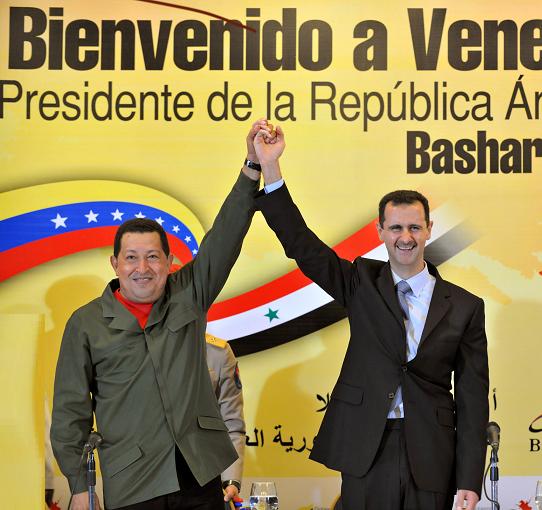
But can we really defend this brutal, oppressive, repressive regime? Wasn’t the much-missed Hugo Chavez just being a bit of a nutcase when he expressed his fondness for “brother President Bashar al-Assad” and worked to counter the offensive against Syria by shipping fuel to it?
As with so many things, we have to start with a total rejection of the mainstream media narrative. The country they paint as a brutally repressive police state, a prison of nations, a Cold War relic, is (or was, until the war started tearing it apart) a dignified, safe, secular, modern and moderately prosperous state, closely aligned with the socialist and non-aligned world (e.g. Venezuela, Cuba, DPR Korea), and one of the leading forces within the resistance axis – a bloc that the imperialists are absolutely desperate to break up.
In the words of its president, Syria is “an independent state working for the interests of its people, rather than making the Syrian people work for the interests of the West.” For over half a century, it has stubbornly refused to play by the rules of imperialism and neoliberalism. Stephen Gowans shows that, in spite of some limited market reforms of recent years, “the Ba’athist state has always exercised considerable influence over the Syrian economy, through ownership of enterprises, subsidies to privately-owned domestic firms, limits on foreign investment, and restrictions on imports. These are the necessary economic tools of a post-colonial state trying to wrest its economic life from the grips of former colonial powers and to chart a course of development free from the domination of foreign interests.”
The Syrian government maintains a commitment to a strong welfare state, for example ensuring universal access to healthcare (in which area its performance has been impressive) and providing free education at all levels. It has a long-established policy of secularism and multiculturalism, protecting and celebrating its religious and ethnic diversity and refusing to tolerate sectarian hatred.
Syria has done a great deal – perhaps more than any other country – to oppose Israel and support the Palestinians. It has long been the chief financial and practical supporter of the various Palestinian resistance organisations, as well as of Hezbollah. It has intervened militarily to prevent Israel’s expansion into Lebanon. It has provided a home to hundreds of thousands of Palestinian refugees, who are treated far better than they are elsewhere in the Arab world. In spite of massive pressure to do so – and in spite of the obvious immediate benefits that it would reap in terms of security and peace – it has refused to go down the route of a bilateral peace treaty with Israel. Palestine is very much at the forefront of the Syrian national consciousness, as exemplified by the Syrians who went to the border with Israel on Nakba Day 2011 and were martyred there at the hands of the Israeli ‘Defence’ Forces.
True to its Pan-Arabist traditions, Syria has also provided a home to hundreds of thousands of Iraqi refugees in the aftermath of NATO’s 2003 attack.
Whatever mistakes and painful compromises Ba’athist Syria has made over the years should be viewed in terms of the very unstable and dangerous geopolitical and economic context within which it exists. For example:
It is in a permanent state of war with Israel, and has part of its territory occupied by the latter.
While it has stuck to the principles of Arab Nationalism and the defence of Palestinian rights, the other frontline Arab states – Egypt and Jordan, along with the reactionary Gulf monarchies – have capitulated.
It has suffered constant destabilisation by the western imperialist countries and their regional allies.
It shares a border with the heavily militarised pro-western regime in Turkey.
It shares a border with the chronically unstable Lebanon (historically a part of Syria that was carved out in the 1920s by the French colonialists in order to create a Christian-dominated enclave).
Its most important ally of the 70s and 80s – the Soviet Union – collapsed in 1991, leaving it in a highly precarious situation.
Its economic burdens have been added to by longstanding sanctions, significantly deepened in 2003 by George W Bush, specifically in response to Syria’s support for resistance movements in the region.
Its economic problems of recent years have also been exacerbated by the illegal imperialist war on Iraq, which created a refugee crisis of horrific proportions. Syria absorbed 1.5 million Iraqi refugees and has made significant sacrifices to help them. Given that “Syria has the highest level of civic and social rights for refugees in the region,” it’s not difficult to understand how its economic and social stability must have been affected.
In recent years, Syria has been suffering from a devastating drought “impacting more than 1.3 million people, killing up to 85 percent of livestock in some regions and forcing 160 villages to be abandoned due to crop failures”. The root of this problem is the Israeli occupation of the Golan Heights, as one-third of Israel’s water is supplied from Golan.
Given the number of different religious sects and ethnicities within Syria, it has never been difficult for the west and its regional proxies to stir up tensions and create unrest.
While there is clearly a need to enhance popular democracy and to clamp down on corruption and cronyism (in what country is this not the case?), this is well understood by the state. As Alistair Crooke writes: “There is this mass demand for reform. But paradoxically – and contrary to the ‘awakening’ narrative – most Syrians also believe that President Bashar al-Assad shares their conviction for reform.”
So there is every reason to defend Syria. Not because it is some sort of socialist utopia, but because it is an independent, anti-imperialist, anti-zionist state that tries to provide a good standard of living for its people and which aligns itself with the progressive and counterhegemonic forces in the region and worldwide.
Tasks for the anti-war movement
If the anti-war movement can agree on the need to actively defend Syria, then its tasks become relatively clear:
Clearly explain to the public that this is not a revolution or a civil war, but an imperialist war of regime change where the fighting has been outsourced to sectarian religious terrorists. It is not part of a region-wide ‘Arab Spring’ process of “overthrowing reactionary regimes”; rather, it is part of a global process of destabilising, demonising, weakening and removing all states that refuse to play by the rules. It is this same process that brought about regime change in Libya, Iraq, Afghanistan, Yugoslavia, Grenada, Nicaragua, Chile, Argentina, Congo, Iran, Guatemala, Indonesia, Brazil and elsewhere. This process was described in a very clear, straightforward way by Maurice Bishop, leader of the socialist government in Grenada that was overthrown 30 years ago: “Destabilisation is the name given to the newest method of controlling and exploiting the lives and resources of a country and its people by a bigger and more powerful country through bullying, intimidation and violence… Destabilisation takes many forms: there is propaganda destabilisation, when the foreign media, and sometimes our own Caribbean press, prints lies and distortions against us; there is economic destabilisation, when our trade and our industries are sabotaged and disrupted; and there is violent destabilization, criminal acts of death and destruction… As long as we show the world, clearly and unflinchingly, that we intend to remain free and independent; that we intend to consolidate and strengthen the principles and goals of our revolution; as we show this to the world, there will be attacks on us.”
Stop participating in the demonisation of the Syrian state. This demonisation – repeating the media’s lies against Syria, exaggerating the negative aspects of the Syrian state and downplaying all the positive things it has done – is totally demobilising. It is preventing the development of a meaningful, creative, courageous, audacious anti-war movement.
Campaign for an end to trade sanctions on Syria.
Campaign for an end to the arming and funding of rebel groups by the British, French and US governments and their stooges in Saudi Arabia, Qatar, Turkey, Jordan and Kuwait.
Send peace delegations to Syria to observe the situation first hand and report back. The recent delegation by Cynthia McKinney, Ramsey Clark, Dedon Kamathi and others is an excellent example that should be emulated.
Campaign for wide-ranging industrial action in the case of military attack.
Support all processes leading to a peaceful, negotiated resolution of the Syrian crisis, reflecting the will of the vast majority of the Syrian people.
The defence of Syria is, at this point in time, the frontline of the struggle worldwide against imperialist domination. It is Korea in 1950, Vietnam in 1965, Algeria in 1954, Zimbabwe in 1970, Cuba in 1961, Nicaragua in 1981, Iraq in 2003, Libya in 2011, Palestine since 1948. It’s time for us to step up.
Further reading
Patrick Seale’s biography of Hafez al-Assad, ‘Asad: The Struggle for the Middle East’, provides an excellent overview of 20th century Syria and a very balanced, detailed depiction of the Ba’athist government.
The following articles are also particularly useful:
Alastair Crooke: Unfolding the Syrian Paradox
Asia Times: A mistaken case for Syrian regime change
Amal Saad-Ghorayeb: Assad Foreign Policy (I): A History of Consistence
Amal Saad-Ghorayeb: Assad Foreign Policy (II): Strategies of Confrontation
Monthly Review: Why Syria Matters: Interview with Aijaz Ahmad
Stephen Gowans: Syria, The View From The Other Side
Stephen Gowans: What the Syrian Constitution says about Assad and the Rebels
Up-to-date anti-imperialist analysis of the Syria crisis can generally be found at Workers World, Liberation, FightBack, Lalkar, Socialist Action, Global Research, Pan-African News Wire, Proletarian, What’s Left and ASG’s Counter-Hegemony Unit.

Capitalism is in crisis. On this point all are agreed. But what is the crisis? How can it be solved? Is capitalism the ‘end of history’, as Francis Fukuyama famously said after the counter-revolutions in the USSR and Eastern Europe in 1989-91? Will capitalism simply ‘sort itself out’? Is it the best of a bad lot, as Churchill and Thatcher maintain?
OR is it up to you and me, the working people to lay hold of the means of production – the factories, mines, banks, offices, warehouses, shopping empires, shipping, rail, trucking conglomerates, and run them ourselves; to plan production sustainably to satisfy OUR basic needs and to meet OUR pressing interests.
For what will be the cost exacted from the masses of working people of the world in ‘blood and treasure’ for capitalism’s ongoing existence? Can the world bear yet more “belt tightening”, poverty, misery, ill health, malnutrition, environmental degradation, unemployment – with all the physical and spiritual degradation that these entail – and deaths from economic and political causes – notably war and famine? And why? All so the few hundred billionaires can carry on amassing obscene amounts of wealth at our expense!
In this talk, Ella Rule explains the economics of capitalism, including the basics of Karl Marx’s Classic “Das Capital” and Lenin’s “Imperialism”. Only by understanding the problem, can we find a solution. How is value created? how is it amassed? Of what does exploitation consist (How are workers robbed of the values they create?)
Watching this video introduction is a vital step – that takes us closer to the goal of building a movement with the understanding to tackle our parasitic and decadent ruling class; place workers in control; and enable us to build an economy that serves the interests of the vast masses of humanity. Please watch and help to spread it far and wide. You are welcome to repost it, but please acknowledge your source.
“The capitalists are our implacable enemies. Their wealth is built upon our poverty, their joy upon our misery!”
There is not a crime that capitalists will not commit to preserve their monopoly over the means of production, distribution and exchange. The only fitting punishment is to deprive them of their ill-gotten gains.
Our revenge will be the laughter on the faces of our children. A better world is possible.
http://www.cpgb-ml.org
https://redyouth.org
http://www.youtube.com/ProletarianCPGBML
Join the struggle! http://www.cpgb-ml.org/index.php?secName=join