If your hanging about in Kent today, why not pop down and speak with Red Youth and cpgb-ml comrades who are today running a stall at the Kent Miners Festival which is being held in Aylesham, Kent. There’s a Miners Band, dance performances a tug of war and of course, the cpgb-ml shop!
Comrades and friends from across Birmingham and the country came to Camp Hill on Saturday to protest against the ongoing disgrace which is being perpetrated by West Midlands Police. Kingsley Burrell called police to his home last summer to deal with a disturbance being created by youths outside his home. When police arrived they arrested Kingsley and took him off to the notorious Mary Seacole House next to Winson Green gaol in Birmingham. Three days later, Kingsley (with no history of mental illness) was pronounced dead and no body has yet been released to the family.
Birmingham cpgb-ml and Red Youth marched last year with Kingsley’s family and we turned out again this year. The pictures are courtesy of Stalingrad O’Neill and the following article is reproduced from Proletarian 2012:
Lessons of the murder of Stephen Lawrence
Police racism can no more be abolished under capitalism than can racism generally – it is a vital weapon in the bourgeois armoury of divide-and-rule tactics that keep the working class weak and impotent.
Two of the murderers of Stephen Lawrence are behind bars – at last. Gary Dobson and David Norris will spend a considerable period of time in prison. But we cannot now heave a sigh of relief and say, “justice has been done – all is now well”.
This is not only because at least three other murderers of Stephen Lawrence are still free, nor just because minimum sentences of 14 and 15 years for Dobson and Norris cannot be described as severe (certainly not when compared with draconian sentences handed out for such offences as taking a bottle of water from a shop during the uprising last summer!)
It is because the struggle is by no means over. All is not well. Racism continues to rear its ugly head. And the context is a working class that is being burdened with the effects of the crisis of capitalism, and receiving heavy treatment from the state, not least the police, when it resists. The intention to divide and thus weaken the working class by fomenting racism has to be fought against and overcome.
Racist murder
Stephen Lawrence was stabbed to death on the night of 22 April 1993 by a gang of at least five young white men, who attacked him and his friend Duwayne Brooks at a bus stop in Eltham, southeast London. It was clear, not only from the nature of the attack but very explicitly from words used during it, that it was a racist attack. Stephen Lawrence was murdered for the sole reason that he was black.
Doreen Lawrence, Stephen’s mother put it very succinctly after the guilty verdict on Dobson and Norris on 3 January this year, following a trial that began on 15 November 2011. She was quoted in the Guardian of 4 January as follows:
“How can I celebrate when I know that this day could have come 18 years ago if the police, who were meant to find my son’s killers, had not failed so miserably to do so?
“This result shows that the police can do their job properly, but only if they want to.
“The fact is that racism and racist attacks are still happening in this country and the police should not use my son’s name to say that we can move on.”
And Neville Lawrence, Stephen’s father said: “I don’t think I will be able to rest until they are all brought to justice.”
Campaign driven by the Lawrence family
Doreen and Neville Lawrence are remarkable people. It is they who have not let go. They just kept demanding, and made good use of the support they received from the Daily Mail to keep Stephen’s murder in the public eye.
The editor of that paper had come into contact with Neville Lawrence when the latter did some building work at his home. This personal interest in the matter resulted in a campaign in the Daily Mail, including a front page of photographs of five men, including Dobson and Norris, which called them murderers and challenged them to sue.
Driven by Doreen and Neville Lawrence, the British state was forced into mounting the Lawrence Inquiry, which among its findings concluded that there was institutional racism in the police force. And now, 18 years after the murder, there have been two convictions.
These convictions were not owing to the fact that new forensic techniques improved the evidence. They were certainly significant in the trial, but the fact is that so much forensic evidence was ‘lost’ by police inaction at the time of Stephen’s murder.
For instance: a police photographer carrying out surveillance on the Norrises and their associates saw black bags being taken away from their house soon after the murder, which could well have contained bloodied clothing, but the men were not intercepted and the bags were never recovered. And so it goes on.
It is the determination and publicity that makes Stephen’s murder remarkable. Many other racist attacks and murders have taken place, but the treatment received by the Lawrences and by Duwayne Brooks indicates how much pressure there is to silence protest.
When the police arrived at the scene of the murder they concentrated their attention on Duwayne, accusing him of being in a gang, assuming that Stephen’s injury was the result of a gang dispute, that he had started everything, etc. They refused to look for the murderers, although Duwayne told them which way they had gone. Duwayne has since been stopped many times by the police, and there have been many slanderous attempts, not least on the internet, to destroy his character.
In an interview in the Guardian on 28 January 2012, Doreen Lawrence underlined that the police failed to find her son’s murderers, but stopped his brother 20 times as a criminal suspect! She herself was stopped a year after the murder, ‘suspected of driving a stolen car’.
Lessons not learned
Some say that “lessons have been learned”, that “justice has been done” and that “we should now move on”. Assistant Commissioner Cressida Dick claimed the convictions were a victory for British justice.
The same Cressida Dick was the officer in charge of ‘anti-terrorist surveillance’ when Jean Charles de Menezes was shot dead by police officers, a fact that was even noted in a letter in the Guardian on 5 January 2012. Another letter on the same day welcomed the convictions and added “Would that the killers of Blair Peach, and those who protected them down the years, might some day occupy the same dock at the Old Bailey.”
How can ‘lines be drawn under’ and ‘moving on’ take place when the United Families of those killed in police custody still campaign without redress? When only recently Mark Duggan was hauled out of a taxi and shot dead through the head by police? The latter sparked a justified uprising, but did not demonstrate ‘lessons learned’ by the police.
Our lessons
So much more could be said, but it is we who need to learn the lessons.
On the one hand, our bourgeois politicians of all shades make pious statements deploring racism. On the other hand, they, at every opportunity, peddle the idea that all the ills of our society are caused by black people, by ‘multiculturalism’, by immigrants. And they preside over detention centres, concentration camps for so-called ‘illegal immigrants’, still incarcerating young children, and over security firms that ‘manage’ deaths of deportees on planes.
It is not that they have failed to learn lessons. The arms of the bourgeois state have learned their lessons well. They know that the aim is to divide the working class as much as possible in order to make it easier to keep it down when it protests against the conditions that imperialism imposes on it. (Remember the draconian sentences following the uprising last summer, and the attempts to blame it, without foundation, on gangs – especially black gangs!)
All power to the Lawrence family and its supporters. Much has been achieved. But we must all take up and continue the fight against racism, which indeed is a fight against imperialism. And we must not be blinded by the fact that the murder of Stephen Lawrence took place 18 years ago so that we do not see what is going on around us now. Unless we understand the reality of the bourgeois state, unless we forge the maximum working-class unity, not least by fighting resolutely against racism, we will never achieve anything.
It is the fashion of the apologist for imperialism to claim the Karl Marx is now irrelevant. That is becoming increasingly a futile claim, as can be shown in so many ways. Suffice it for the moment to just remember that it was he who said, “Labour in the white skin cannot be free where in the black it is branded.” (Capital, Vol 1, 1867)
Comrades from Red Youth and the CPGB-ML have returned from a short delegation to Derry. Comrades were taken on a tour of the Bogside and other nationalist communities, and to a number of important Republican memorials and were able to hold discussions with comrades and friends from Sinn Fein, Sinn Fein Republican Youth and meet others from the wider republican family. The warmth and cameraderie of the visit was matched only by the insights into the practical organisational work undertaken by these comrades and the delegation learnt many lessons which it can take back to Britain in our work here.
Solidarity with the Irish people’s struggle for self determination has been a hallmark of the work of the CPGB-ML since its inception, and has been taken up by the youth since the formation of Red Youth in 2010. The following motion was passed at the 2010 Congress of the CPGB-ML:
“Ireland
Congress reaffirms our solidarity with the struggle of the Irish people for self-determination, independence and reunification, as expressed at our founding congress and subsequently. The Irish people have struggled for centuries to restore their legitimate national rights and still do so today. Their unyielding spirit in the face of overwhelming odds has inspired freedom fighters throughout the world and continues to do so.
Through a masterful combination of political and armed struggle, the Irish people, led by the republican movement, forced the incomparably stronger forces of British imperialism into a state of strategic stalemate. Since then, Sinn Fein has skilfully built on the gains of the previous period of struggle to advance a political process aimed at reconciling the historic antagonisms fostered between Irish people by British imperialism through its strategy of ‘divide and rule’.
Congress welcomes the further step towards a united Ireland represented by the Hillsborough Castle Agreement (HCA) signed on 5 February 2010. This agreement, effective from 12 April, transfers the control of policing and justice in the six counties from British to Irish soil, brings parades legislation under local control and clears the way for the long-awaited implementation of the Good Friday and St Andrew’s agreements.
This tactical achievement is the fruit of lengthy political struggle led by Sinn Fein, whose growing political strength both in the occupied north east and in the rest of the country has obliged even the hard-line unionist sectarians of the DUP (Democratic Unionist Party) to bow to the inevitable. That is why the DUP dropped their arbitrary precondition that the Orange Order be given carte blanche to march up the Garvaghy Road – only the latest in a long line of delaying tactics dreamed up by these unionist diehards, doubtless encouraged in their pathetic obstinacy by reactionaries in the Northern Ireland Office itself.
Congress reiterates the demand that British imperialism and its unionist stooges stop all further foot dragging and immediately and fully implement all provisions of the Good Friday and St Andrew’s agreements as a step towards full British withdrawal from Ireland and the affairs of the Irish people, national reunification and independence.
It is well known that Karl Marx and Frederick Engels repeatedly taught that the British working class must support the Irish not only as a matter of justice for Ireland but above all in their own class interest. It absolutely remains the case that the British proletariat will remain slaves to capital unless and until they learn to support the struggle of the Irish, the Iraqis, the Afghans, the Palestinians and every other oppressed nation that rises up to challenge imperialist domination.
For that reason, our party will continue to support and campaign with Irish community and anti-imperialist organisations standing for national reunification and an end to British interference in Irish affairs, including the Wolfe Tone Society and the Troops Out Movement. In particular, we will support the international campaign to “put Irish unity on the agenda”, which Sinn Fein has launched in Canada, the USA and Britain in recent widely supported rallies.”
This report from Cuba by our party’s recent delegation will bring fresh inspiration to all those struggling against imperialism. Not only can we win, but a bright and dignified future awaits us on the other side of the revolution.
At the end of June¬¬, the Communist Party of Cuba (PCC) hosted a delegation of CPGB-ML comrades, led by our chairman Harpal Brar and vice-chairman and international secretary Ella Rule.
The exchange was characterised by a spirit of sincere friendship between the working people of Britain and Cuba and true comradeship between CPGB-ML delegates and our Cuban hosts, borne of a remarkable harmony of outlook and realisation of our common interests and destinies.
We were privileged to meet members of the PCC’s central committee and delegates of the National Assembly of People’s Power (the Cuban people’s parliament), including Ramon Pez Ferro, who was the youngest member of Fidel Castro’s company when it stormed the Moncada barracks on 26 July 1953.
Meeting with cde Ramon Pez Ferro, President of the Commission of International Relations for the People’s Power National Assembly. Cde Ramon was also the youngest member of the rebels that stormed the Moncada Barracks on 26 July 1953 alongside Fidel and Raul Castro, marking the begining of the Cuban Revolution
It was this attack on the Moncada barracks, challenging the corrupt rule of US puppet Fulgencio Batista, that served as a call to arms to Cuba’s finest revolutionary youth and gave rise to the July 26 Movement (M 26-7). That movement went on to overthrew the brutal Batista dictatorship on 1 January 1959 and laid the foundations of the modern socialist state of Cuba.
We met leaders of the youth movement (CJC), women’s federation and trade unions, as well as health workers and cooperative farmers. All told us of their current struggle to build a productive and efficient socialist economy, to improve the material conditions of the Cuban people and to safeguard the gains of the revolution.
The delegates presented our Cuban hosts with literature – issues of Lalkar and Proletarian, pamphlets, and books – which was warmly received and has been placed in the national libraries of the Cuban parliament, as well as in the libraries of the PCC central committee, the Federation of Trade Unions, and the women’s and youth organisations.
Much has been written recently of Raul Castro’s introduction of market reforms to Cuba; the ‘deregulation’ of the Cuban labour market and the hundreds of thousands of workers who are consequently entering the private sector. Many commentators tell us to expect the impending collapse of Cuban socialism.
It was therefore of special value to visit Cuba at this crucial time, following the sixth party congress of the PCC in 2011, while its decisions are in the process of implementation.
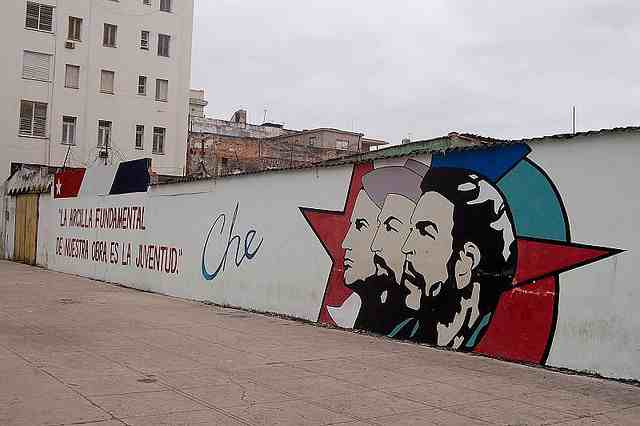
Che Guevara famously wrote that “the true revolutionary is guided by a great feeling of love. It is impossible to think of a genuine revolutionary lacking this quality … Our vanguard revolutionaries must idealise this love of the people, of the most sacred causes, and make it one and indivisible.” (‘Socialism and man in Cuba’, Marcha, 12 March 1965)
We found both the historic leadership and Cuba’s new generation of leaders to be talented and hard-working, self-disciplined and incorruptible people, who lead by example and common consent, in the spirit of Che’s precept.
Meeting with the central committee of the PCC
Comrade Oscar Martínez Cordovés, deputy head of the department of international relations of the CC, welcomed the CPGB-ML’s visit enthusiastically, and noted that “You are visiting Cuba at a very interesting time … This year we commemorated, among other things, the fiftieth anniversary of the missile crisis, which as you know brought the world to the brink of nuclear war. This event is closely linked with US imperialism’s ongoing attempts to strangle Cuba.
“Today the danger of war is far greater than in 1962. The international situation is extremely complex and unstable. The economic crisis in the eurozone typifies this instability. The EU project was designed to merge and safeguard the interests of European finance capital …
“In Europe, the International Monetary Fund and the European Central Bank are overturning national sovereignty and determining the policies to be followed.
“You are visiting Cuba at a time when we have been outlining the main problems on which we need to focus: how to build our economy in the current international and national situation.
“Cuba is a small island of 12 million people and limited national resources, which has been subjected to a strict economic blockade by the most powerful country on earth, sitting just 90 miles from our shores. Under these circumstances, how do we strengthen socialism?
“There is a lot of talk about Cuba at present: whether Cuba is going in a Vietnamese way or a Chinese way? In fact, we are following our own method of development along an untrodden path …
“In the lead-up to the sixth party congress we held extensive discussion among the masses to ascertain their needs and aspirations, and it became clear to us that above all we needed to strengthen our economy. This is our most basic requirement to fulfil all our needs and internationalist duties.
“We seek to develop a socialist economic model that is efficient, sustainable and gives us the real possibility of safeguarding our social programmes and the gains of our people. The PCC seeks to undertake the political and ideological work necessary to achieve this goal.
A socialist planned economy is the chosen model of the Cuban people
“After extensive consideration of several models, the sixth party congress reaffirmed that our economic model of development should be a socialist model characterised by planning, and not by the market. We are clear that social property should remain the principal element of production. In addition, we have cooperative production undertaken by individuals who lease social property, and individual workers who work on their own account …
“The 1976 constitution guarantees the right of every citizen to employment, and we wish to preserve that right. But we have created too many unnecessary and unproductive roles, which has inflated the state payroll burden. We need to reduce unproductive expenditure on unnecessary salaries and reallocate workers in order to increase productivity and strengthen our economy.
“The IMF would solve this problem immediately with ‘shock therapy’ – by turning workers out into the street. That is capitalism. Under socialism we cannot do this. We must reorientate and redeploy unproductive workers into productive sectors where our economy really needs them. The principal sector where we need more workers is in agriculture, in order to produce more of our food requirements domestically and reduce imports.
“We also want to reduce our expenditure on the service sector and stop providing all services, some of which can better be provided by individual workers – such as barber shops and beauty parlours.
Increasing productivity is the focus of the sixth congress of the PCC
“Our principle problem consists of low labour-productivity …
“Although we are a small island, we have enough land to produce all our food needs. However, we are producing just 30-40 percent of our food requirements at present. Since making these decisions, we are already seeing improvements in our economy, and have been able to reduce some imports.”
Comrade Harpal Brar, in discussion with Comrade Oscar, said: “We completely agree with you that socialism cannot be built unless there is a high productivity of labour. If we cannot produce more productively than capitalism then socialism has no future. That is clear from the days of Marx and I think everybody is clear about that.
“But again, production has a purpose. Under socialism, production is to satisfy the needs of the people. If productivity rises but it ceases to have any connection with the needs of the people, then there is no point having production. American capitalism is able to produce, although this may seem unbelievable, more productively than the Chinese and many others, but their production is not for ordinary people, which is why there are 40 million people in the USA who have no health cover and 15-20 percent of the US population go hungry. There is no reason for America to go hungry.
“You have told us that you need to increase productivity, but in increasing productivity, you’re not forgetting the needs of the Cuban people … I’d like to thank the Communist Party of Cuba for inviting us and giving us the opportunity to listen to you face to face …
“We support Cuba. But we don’t do it as a favour to you. It is our proletarian internationalist duty. If Cuba is successful – to the same extent we are successful as well. If we are successful in building a strong movement in our country, this is of some help to Cuban communists and other socialist countries. So we really very much hope that you are able to combine Bolshevik zeal with American efficiency!
Cuban socialism a beacon of hope
“We hope you make tremendous progress. Cuba has surprised the whole world by holding on to its socialism … As soon as the Soviet Union collapsed, imperialists were waiting like vultures, asking ‘When is Cuba going to collapse?’, ‘When are China, Vietnam and north Korea going to fall down?’ They have been waiting for a very long time – and I hope they will wait forever!
“Cuba exercises on the world stage an influence disproportionate to its size, its population or resources. This is because of its selfless help to other people, both in the fields of medicine and education, as well as in armed combat.
“You have sent soldiers to defend liberation movements in Africa, and you have given all kinds of help, and Cubans are known in those areas. Even muslim fundamentalists in Pakistan actually appreciate what Cuba does. When the earthquake hit Kashmir, Cuban doctors provided immediate unconditional help. That is the kind of help that needs to be given – not what the Americans gave to Haiti, where they come to loot the people, conduct espionage, and sabotage any progressive movement.
“Cuba is doing exceptionally well and we want to thank you.”
Achievements in health in Cuba; defying the US blockade
Visiting Hermanos Ameijerias hospital in Havana, the delegation toured the modern facility and discussed Cuba’s health system with Dr Gonzalo Estévez Torra, epidemiologist and medical director. He explained that the Cuban model of health is based on our own NHS primary-care system, but with an emphasis, like the Soviet Union, on preventative as well as curative medicine. “At the primary and polyclinic level in the provinces, 80 percent of Cuba’s health needs are met,” he said.
Hermanos Ameijerias Hospital, Havana
“Health care is free of charge to the population. The government also offers a great deal of medical aid abroad. This is very expensive for the Cuban state. The American blockade denies us access to medicine and equipment we could otherwise buy cheaply locally. Because of this, Cuba has been forced to develop its own medical technology and pharmaceuticals industries.
“Cuba now produces 70 percent of the drugs we consume. When we need a medicine, we often have to source it in Europe or Asia, but if equipment has an American component then the US applies its sanctions, preventing us from buying it …
“Today, we are vaccinating our children against 18 diseases. Eleven of these vaccines are produced in Cuba. This is our response to the blockade. We have become more self-sufficient and even export some of our medicines – for example a uniquely chemically-synthesised vaccine against haemophilus influenza.
“Life expectancy of Cuban men is 76 years and of Cuban women is 80. We have an infant mortality of fewer than 5 per 1,000 live births. These figures are better than those of the USA. Free public health is for all Cubans regardless of race, gender, religion or economic status.”
The achievements of the Cuban health system are inspirational, especially when one remembers the position of pre-revolutionary Cuba, where only a handful of doctors practiced, and almost all of them resided in Havana, tending exclusively to the tiny parasitical class of US businessmen and their local stooges.
Comparing Cuba’s healthcare indices to the vast majority of Caribbean, Latin-American or oppressed countries today tells an even more stark story. Even in comparison to the health systems of the richest imperialist nations, Cuba’s achievements are enviable.
Comrade Ranjeet, a delegate and also a healthcare worker in Britain, commented that “In our country we have a national health system which was introduced in the 1940s, but for the last 30 years there has been a growing pressure to divide it up and privatise it, to turn it into something much like the US health system.
“For a long time the NHS was considered the envy of the western world. Our health indices are similar to Cuba’s, but it costs 5-6 times as much to produce them. The NHS costs about £100-110bn per year to run – although funding is currently being cut [by some 20 percent]. But much of that finance ends up in the hands of private pharmaceutical multinationals, medical technology companies and now also PFI contractors and financial consortia. Private companies make a huge amount from that ‘public’ money.
“Cuba shows that through rational planning, and with nationalisation of pharmaceutical and medical technology companies, it is possible to provide very good health care for all, efficiently and cheaply… In Britain, at the current rate of ‘reform’, our NHS system will not exist for very many decades longer.”
People’s Power National Assembly
Meeting Comrade Ramon Pez Ferro, president of the commission of international relations at the People’s Power National Assembly (PPNA), Comrade Harpal told him that:
“We are here to express solidarity with the Cuban people, and to say that there are two Britains; the Britain of the working class and progressive people and the Britain of the ruling class … We represent the finest elements of the British working class in coming to be with you. We wish to state unequivocally that the hostile propaganda levelled at you is the work not of the working people of Britain, but of the British ruling class.”
Comrade Ferro replied, saying: “I agree with you when you say there are two Britains – of the workers and capitalists. In that regard, I think we can achieve something. We have [held parliamentary exchanges with] Britain. British parliamentary groups have expressed solidarity with Cuba on issues such as the Miami Five. All of this has achieved some results – although limited.
“In Britain there are important non-parliamentary solidarity movements and organisations, and these and British trade unions have expressed their solidarity with Cuba. For us it is very important to receive groups such as yours and those I have mentioned.
“Cuba is a victim of the US propaganda campaign that slanders the reality of our daily life. This type of campaign is also very much alive in Europe and Great Britain. The US state department has approved an additional twenty million dollars of funding for mobile-phone propaganda and misinformation campaigns, as well as financing dissident groups to wage campaigns of destabilisation and subversion in our country.
“This is a direct continuation of the war of destabilisation that the US has never ceased waging against Cuba since the revolution of 1959. It is part of the general and comprehensive policy of US imperialism – and not only against Cuba. It is aimed against all progressive movements. The methods change, but the objectives remain the same.
“They used to threaten Cuba with force. Today they use direct force against the peoples of the world, as well as all their other methods of economic and political destabilisation. They have absolutely no moral or ethical standards.
“For several years we have seen a change of the political situation in our continent. The previous subservient governments, subordinate to the USA, have been replaced in many cases by independent governments that pursue the interests of the Latin-American people. Anti-imperialist resistance has strengthened.
“These governments are all facing the same treatment that Cuba is facing. This was the same policy used against Honduras, and in Venezuela. There also, president Chávez faced a military coup d’état, and was kidnapped by airborne US forces. It was only the courageous actions of the people that prevented its success and obliged imperialism and its local agents to turn their helicopters around, to spare Chávez and return him to the presidency.
“In Ecuador, there was an uprising of the police, putting in danger the life of president Rafael Correa. In Bolivia now there is a very difficult situation, using the same methods – an uprising of a group within the police force, on a spurious pretext.
“Around the world, similar situations can be found: the US-sponsored ‘free army’ in Syria; the US-sponsored ‘colour revolutions’ in Iran and other places; the overthrow of Gaddafi; Afghanistan; Iraq: the USA is seeking, through its policy of force, to control the world in order to dominate its economy and monopolise its wealth.
“That is why it is so important the world’s progressive forces, our movements, identify more and more and get closer and closer. It is only through unity of our peoples that we can oppose imperialism, and prevent it from dominating the peoples of the world.
“Blockade and sanctions are the greatest violations of human rights that it is possible to commit; for these modern-day acts of siege warfare impose privations on the whole population – the elderly, children, pregnant women, the sick and disabled.
“Even in the USA, the overwhelming majority of public opinion is against the blockade, but they pay no attention to the will of their people. Every year at the UN general assembly, a resolution is passed demanding the lifting of the blockade against Cuba. They do so because it is unilateral and illegal, and cannot be accepted even from the purely economic or trading perspective of bourgeois countries.
“Today, Cuba gives exemplary solidarity to the peoples of the world; it is a shining example of how to give security and protection to one’s people. We have experienced difficult and complex circumstances, but there is no family without food, clothing, shelter, culture, education, health care. Despite difficulties resulting form being a poor nation without great wealth of natural resources, and being subjected to 50 years of blockade, our policy of equity and justice has demonstrated that we can give an improved life to the people under socialism.”
No material privilege for leaders of the revolution
In stark contrast to the British parliamentary system, which systematically divorces our MPs from workers, Comrade Ferro told us “I am an MP, and my standard of living as such is the same as the Cuban workers. I give this example because we are here in the PPNA. The same applies to a minister or any other political leader in the country; they enjoy no privilege due to the position they occupy.”
Growing the rural economy
As Cuba’s current economic plan is designed to promote agricultural production, the delegation went to the municipality of Guira de Melena, in Artemisa provence, to visit the ‘1st May’ cooperative farm.
The cooperative has a total area of 774 hectares, of which 602 are under cultivation. Thirty-eight of the participating farms, totalling 236 hectares, are newly cultivated.
The 1 May cooperative is divided into 92 farms with some communal areas. The leading body of the cooperative is the assembly, which has 246 members (187 men and 59 women at present). The assembly elects a managing board of nine people to conduct day-to-day affairs of the cooperative, two of whom are currently women. The board elects a president, to lead the affairs of the cooperative between assemblies, and must present accounts at these meetings.
Bright green crops of sugarcane, banana, yam and cereals sprout from the farm’s deep red, ferrous-rich soil, nourished by the plentiful and often tempestuous rains, under the tropical embrace of the Caribbean sun. Pigs, chickens and rabbits were penned near the farmers’ cottage where we ate. We were treated to a sumptuous lunch of beef and salad sandwiches, tropical fruits and juices, mixed (on occasion) with a little Havana Club rum.
All of the food in our meal was produced by the cooperative, and most on the farm itself. The organically-farmed feast was deliciously fresh, naturally sweet and healthy. Shared with the farm workers, at the farmhouse of the principal leaseholder’s family, the meal became an occasion of real social enjoyment, and conversation was animated.
The rural and agricultural workers were visibly healthy, well fed, well clothed, socially engaged, and concerned with their work. Production targets are not some abstract notion to them, but represent real problems to be solved, real challenges to be met, in cooperation and with the benefit of help from state scientific and technical agencies, academics and advisors, who truly work synergistically to achieve the same broad goals: increased but sustainable production, efficiency, self-reliance, dignity.
While 70 percent of Cuba’s land is owned and run by state farms, the new soils being brought under cultivation are for the most part being leased to individuals, who enter into legal agreements with the Cuban state, and must ensure that the land is put to productive use – on penalty of termination of the agreement.
And new farmers are indeed coming back to the countryside from the towns. Despite the individual nature of the lease agreement, this is far from ‘capitalist farming’. All farmhands enjoy similar working conditions and have an input at weekly meetings into planning and overseeing production.
A proportion of the harvest is sold at pre-arranged prices to the state. On the 1st May cooperative, 25 percent of production was disposed of in this way. Beyond this, the cooperative is allowed to sell its remaining crop. Much of it goes in bulk contracts to other enterprises – schools, hospitals, hotels, or offices – and the rest is sold in open markets in local towns and cities.
School for the disabled
Another memorable visit was to the Solidaridad con Panama special school, a school for the disabled where, at no cost to their families, physically and/or mentally disabled children are trained to be able to work independently if at all possible when they reach adulthood.
In a socialist society, if disability means that one worker is somewhat slower than others this is not a fundamental factor, since production is not for profit, and every little bit that each person can contribute by his or her work to society as a whole is valued as a contribution to the common cause.
Despite the overwhelmingly inspiring nature of our visit to the school, it was distressing to note that the happy little children there were in many cases being deprived of equipment they needed to further enrich their lives because of the blockade. It is surely the grossest infringement of human rights to deny a little child with cerebral palsy an electric wheelchair just because some small part is manufactured in the US or by a US company!
However, neither the staff nor the students at the school we visited were prepared to allow these setbacks to daunt their firm determination that all the children should grow up to lead satisfying and fulfilling lives in their socialist society.
Why the blockade – what do they fear?
Speaking at the CPGB-ML’s summer barbecue last year, Comrade Ranjeet asked why it is that small countries like Cuba, with its 11 million population, and north Korea with its 23 million are perceived as such a threat by mighty US imperialism, with its population of 350 million and a greater military arsenal than the rest of the world combined. The answer that he gave has been strikingly confirmed by our delegation’s visit to Cuba: it is the example that Cuba and other socialist countries set to the oppressed of the world, currently suffering under the jackboot of imperialist domination.
These socialist countries are the living proof that nothing is more precious than independence and freedom, and that it is possible to build a bright and dignified future for workers in which they share the fruits of their common labour without being exploited, and without exploiting the labour-power of others.
This is anathema to the US imperialists’ system of domestic wage slavery and its international network of vassal states and puppet dictatorships designed to help America’s corporate elite plunder and pillage the resources of the entire world.
We wish the Cuban people well in their endeavours to strengthen their economy in line with the plans adopted by the PCC’s sixth party congress. If Cuba is successful – to the same extent we are successful as well: may they indeed combine Bolshevik zeal with American efficiency!
End the blockade!
Free the Miami Five!
Long live the Cuban revolution!
Jose Marti statue in Plaza de la Dignidad (Plaza of Dignity) on the Malecon
Join party members and friends from around the world in celebrating two important anniversaries in the revolutionary calendar:
— the Korean victory in the Fatherland Liberation War
— the storming of the Moncada Barracks in Cuba
Honoured guests and speakers will include:
— representatives from the north Korean, Cuban and Venezuelan embassies
— delegates recently returned from both Korea and Cuba
Come and be inspired as we celebrate two historic achievements of the international working-class movement, and learn about the reality of building socialism under imperialist blockade today. In June 2012 our comrades, at the invitation of the Communist Party of Cuba toured the island, visiting Co=operative farms and hospitals, speaking with those who are leading the Party in its daily struggle against imperialism. Come along and here what they saw,
Touring a newly created Co-op farm in Cuba, June 2012Mural at a school for the disabled in Havana, Cuba – June 2012
Plus cultural performances, tasty barbecue and a decent curry too – all in the company of good comrades.
– Day school on Marxism and Scottish nationalism –
CPGB-ML comrades and supporters will be meeting for a day school focusing on the Marxist definition of a nation and how Marxists apply this understanding to arrive at a correct policy on any particular national struggle. This understanding is vital if we are to make sense of the various liberation struggles going on around the world, and should also help comrades formulate their attitude towards the question of Scottish independence.
The day will be held in two parts, with an introduction to the question given by Harpal Brar during the morning session followed by workshop discussion groups in the afternoon.
Please contact us if you are planning to attend both events and need accommodation over the weekend:
— rango@cpgb-ml.org
Come and hear speeches and contributions from the Venezuelan, Cuban and Korean embassies – and a report back from the CPGB-ML delegation to Havana where Party-to-Party talks were held with the Cuban Communist Party.
This is a social event to celebrate the anniversary of the victory of the Fatherland Liberation War in Korea and the anniversary of the storming of the Moncada Barracks in Cuba.
Followed by cultural performances along with a tasty barbecue and Indian curry!
This year’s Durham Miner’s Gala saw thousands upon thousands of ordinary working class men and women descend on Durham to celebrate working class history and culture. It was clear from the overall mood of many who attended that sections (a minority but conspicuous by it’s presence) of the labour movement are finally beginning to wake up to the reality that cuts must be opposed no matter who tries to introduce them, that the working class needs to move to promote it’s own interests and not those of a small aristocracy of labour who continue to try their very best to link the interests of the working class with those of imperialism.
Despite the organisational stranglehold still asserted by Labour Party bosses over the event – there were plenty of examples of working class people who would have no truck with Labour or Tory arguments for cuts. The appearance of Ed Milliband on the stage was met with an apt banner, provided by one of our most militant and class conscious unions the RMT, the banner was pulled by a small aircraft across the sky. Circling the old racecourse it read “No ConDem cuts – No Labour cuts”.
Down on the racecourse itself others unveiled banners which exposed the hypocrisy of the likes of Miliband:
A major cause of disorganisation amongst workers has been the confusion spread by social democrats over the real nature of the capitalist crisis, which they present as a temporary blip to be sorted out by the next Labour government via ‘sensible’ cuts and some economic pump-priming. But nobody should doubt the scale of the crisis we are entering, or believe that it is just being ‘talked up’ by the Tories to scare us.
Behind the debt crisis that is undermining the US economy and tearing Europe apart lies a deep-seated overproduction crisis that has been brewing for over three decades. More commodities have been produced globally than can be sold at a profit on the market – not because the world’s needs have been met, but because people just cannot afford to buy them.
The problem is further aggravated when capitalists, desperate to beat the competition, slash wages and reduce the workforce, thereby further reducing the masses’ spending power and adding another twist to the spiralling crisis.
Break the link
The good news is that the same capitalist crisis is also chipping away at the material basis for opportunism, since the ruling class can no longer afford to spend so much on buying off its opponents. The time is ripe for the working class to move from cynical mistrust of the Labour traitors to a confident assault upon their stranglehold over organised labour.
While our unions are tied to the imperialist-affiliated Labour party, we will not be able even to fight the cuts, never mind organising to overthrow the whole rotten system that brings poverty and war in its train. This years Durham Miners Gala was the honourable exception to the usual TUC-inspired and controlled austerity protests. Protests that winge on about fighting the cuts but do everything in their power to ensure that working class people don’t lift a finger against the cause of the crisis and the leadership who protect the interests of the rich.There is one abiding slogan that should be embraced by every class-conscious worker as we enter the next stage of battle against the cuts:
IF capitalism makes its own gravediggers; if the workers are gunpowder, knowledge and education the spark that will destroy this rotten system; then social democracy, the Labour Party and their Trotskyite friends are the last line in the imperialist’s defence against the rising tide of dissatisfied and militant workers.
Today, with poverty, unemployment and debt spiralling out of control, and economic crisis set to get worse while wars get bigger and dirtier, it’s certainly true that more and more people even in relatively cushioned imperialist heartlands like Britain are starting to join the class struggle.
They are finally waking up to the reality that this parasitic system has outlived its usefulness and has a future only in the past. Capitalism and imperialism have nothing to offer the vast masses of the world’s people except more poverty, more debt slavery, more war and more human and environmental waste and destruction.
So it’s not surprising that the corporate media and politicians are desperate to persuade us that the pro-imperialists of the SWP etc are the people to join if you want to express opposition to capitalism in Britain. They will be getting plenty more free advertising in the capitalist press from now on, precisely because they will be as much use to workers in making a revolution as chocolate is in making a pot to hold tea.
A short history of Kim Il sung and Korea is followed by scenes from the parade to mark 100th anniversary of Kim Il sung’s birth held recently in Pyongyang. Then follows a presentation given at the CPGB-ML school held in Southall to mark the event.
Ella helps us to understanding North Korea and Juche – which, she explains, means understanding Marxism as it can help to guide the concrete struggle both for working class emancipation in Britain (and the imperialist countries) and liberation of oppressed nations today (in Korea, and elsewhere). Presentation given to mark the 100th anniversary of Kim Il Sung’s Birth.